Test requirements for USB Type-C and Power Delivery standards cover a wide range of components such as hosts, hub modules, docks, monitors, and chargers, all of which are continuously evolving.
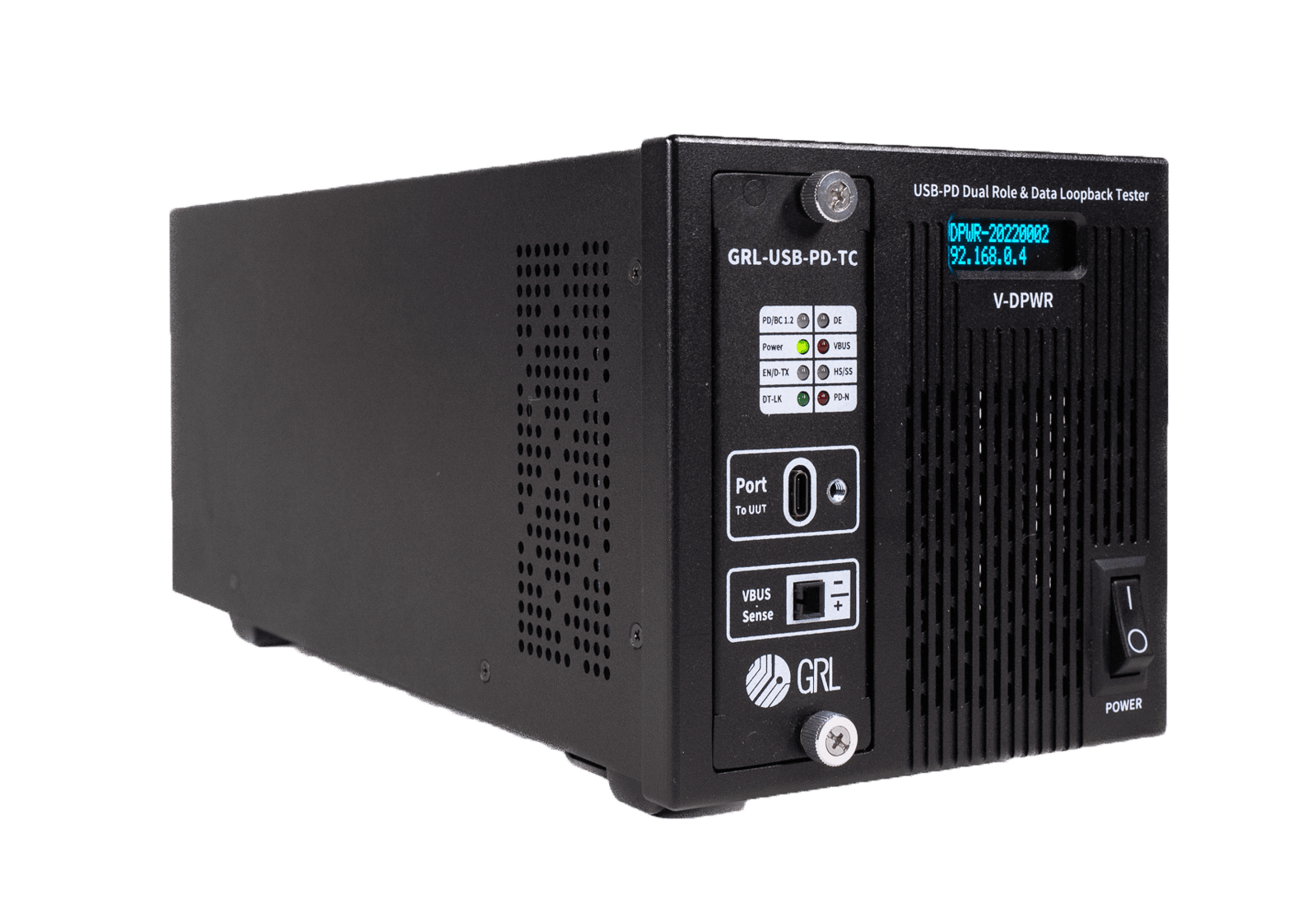
The M1 software is designed to enhance the USB Power Delivery Dual Role Power and Data testing capabilities of the GRL-V-DPWR and GRL-V-UP, which are already capable of running tests accurately and comprehensively. When combined with the M1, these solutions can support even higher volume manufacturing/production floor testing as well as rapid functional verification testing at R&D.
This solution is suitable for functional validation of the following devices (devices labeled with * can only be validated by GRL-V-DPWR):
- Battery Power Bank with USB Power Delivery*
- Laptops, Mobile phones supports USB Power Delivery*
- QuickCharge Chargers
- USB Hubs
- USB Power Delivery Chargers
- USB Type-C Chargers
Key Features
Running the M1 software on GRL-V-DPWR or GRL-V-UP allows engineers to create highly customizable test cases with intuitive visual scripting instead of going through tedious programing automation.
M1 enables the following USB Power Delivery functionality tests on GRL-V-DPWR and GRL-V-UP (Note that functions labeled with * are only available on GRL-V-DPWR):
- USB Power Delivery PDO / APDO validation with configurable load and timing test
- Custom VDM test
- Overcurrent Protection (OCP) tests
- PD contract connect/disconnect/negotiation/re-negotiation tests
- Port Role switching test*
- VBUS & VCONN voltage & power regulation tests
- VBUS voltage and power test
- VCONN voltage and power test
USB Power Delivery data role tests unlocked with M1:
- USB Host data enumeration test
- Data Loop Back verification test
- USB Data Link Seed verification test
The addition of M1 also grants users the following testing and validation features, making it a suitable addition to any engineering or design team that seeks to cover all their bases in USB Power Delivery validation (Note that functions labeled with * are only available on GRL-V-DPWR):
- Battery charge/discharge cycle testing*
- External equipment control integration
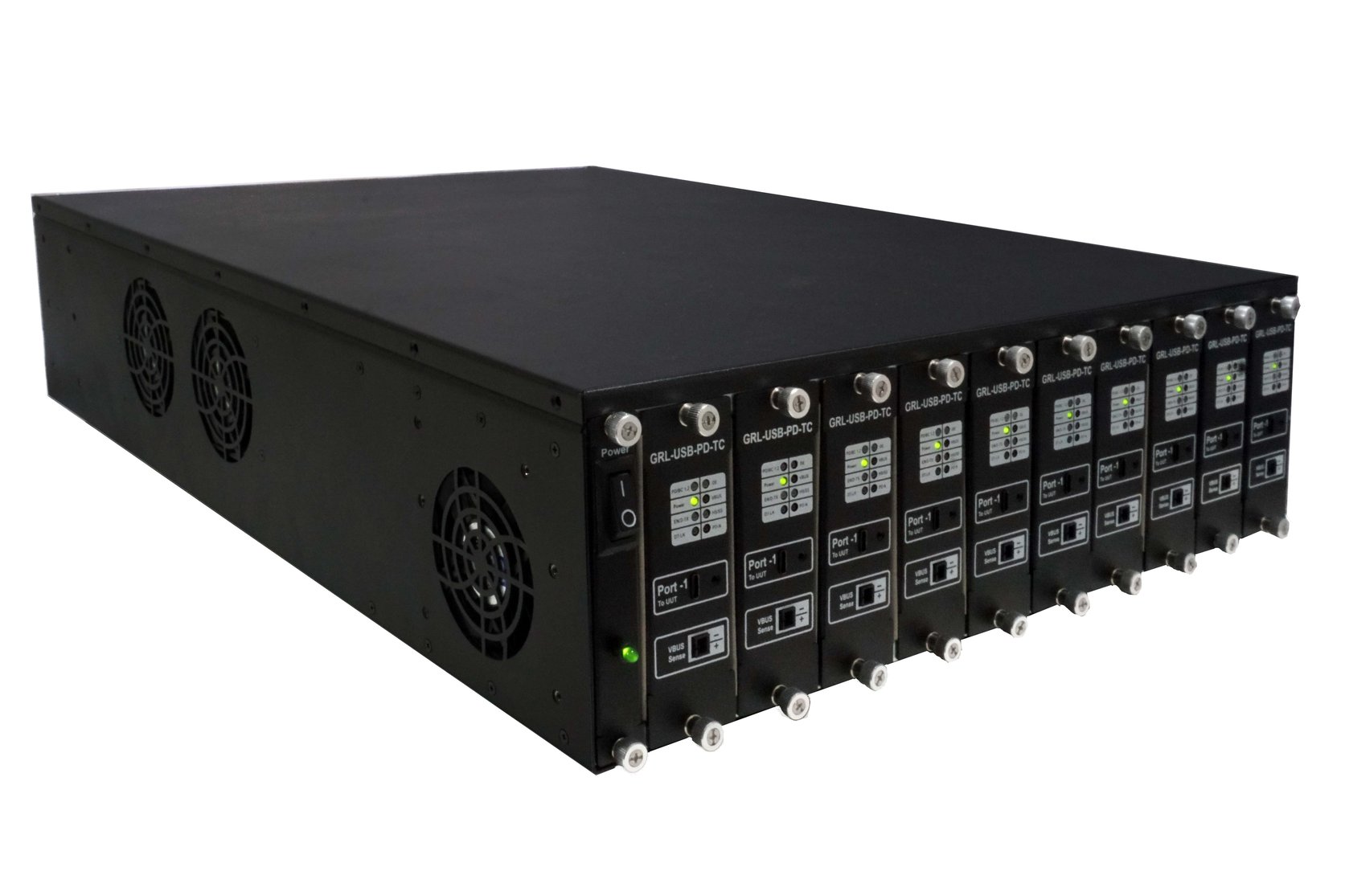
- Multi-port shared power validation (Up to 10)
- Quick Go/No Go tests for manufacturing floor
- USB Power Delivery & QuickCharge functional validation
Report generation and data analysis:
- Comprehensive reporting test module with in-depth pass/fail statistics
- Conduct simultaneous validation of power & data
- Customize reports and export in multiple formats such as CSV, HTML, PDF, etc.
- Execute and aggregate results for up to 10 stations, all controlled by a single controller


%20and%20Data%20Loopback%20Volume%20Tester%20(V-UP)_Software%20running%20image.webp?width=1600&height=643&name=M1%20Automation%20Software%20for%20USB%20PD%20Dual%20Role%20Power%20(V-DPWR)%20and%20Data%20Loopback%20Volume%20Tester%20(V-UP)_Software%20running%20image.webp)
%20and%20Data%20Loopback%20Volume%20Tester%20(V-UP)_Software%20running%20complete%20image.webp?width=1600&height=643&name=M1%20Automation%20Software%20for%20USB%20PD%20Dual%20Role%20Power%20(V-DPWR)%20and%20Data%20Loopback%20Volume%20Tester%20(V-UP)_Software%20running%20complete%20image.webp)